

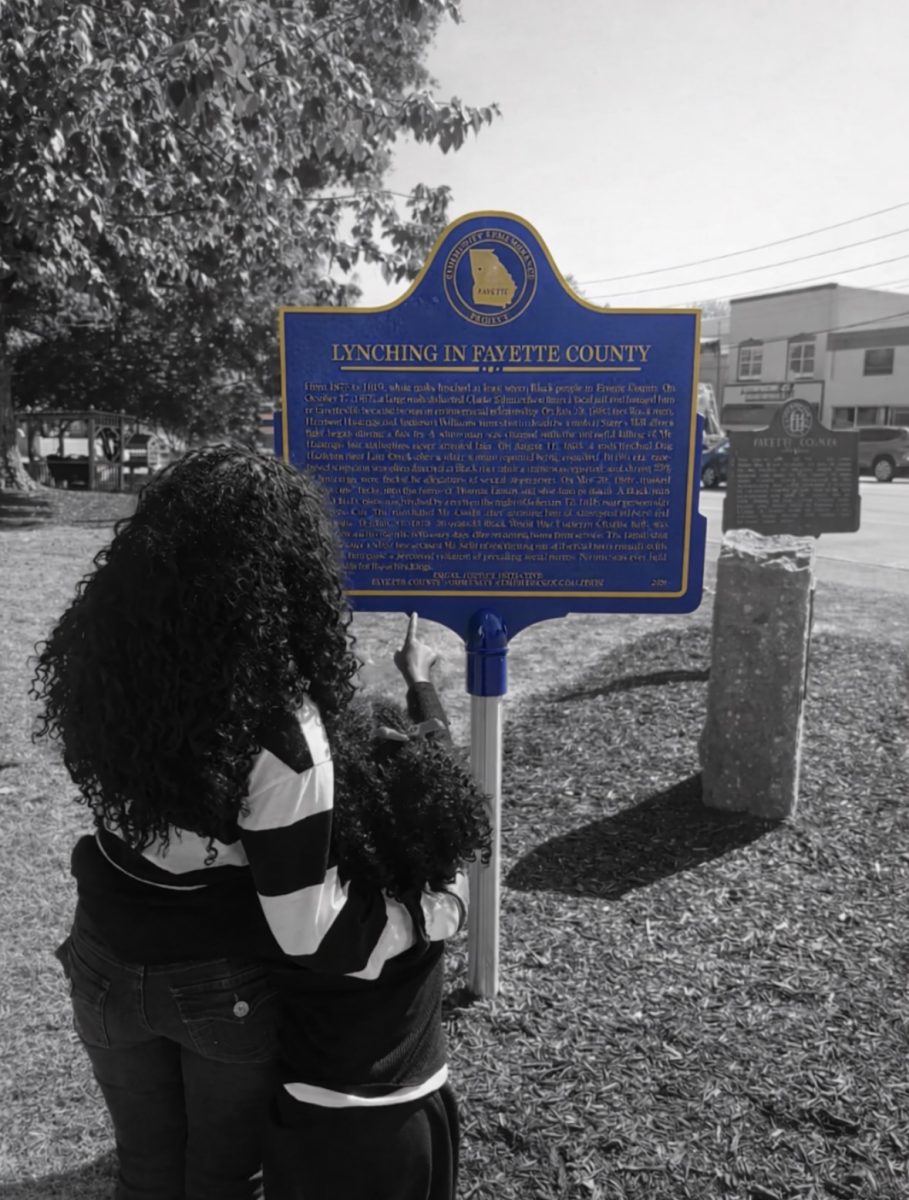
On March 12, the Equal Justice Initiative partnered with the Fayette County Community Remembrance Coalition to establish a historical marker concerning lynchings that took place in Fayette County, Georgia.
The marker details seven horrific murders between 1875 and 1919 that resulted from racism. It stands outside the old courthouse in downtown Fayetteville.
Recalling these events causes readers to think about the unlawful acts that prevailed in times not so long ago, while still honoring the significant progress made in Fayette County.
Rather than telling one story, the marker describes the multiple incidents to show the pattern of injustice. The documented victims include Clarke Edmunson, Harrison Hasting, Anderson Williams, Dug Hazleton, Thomas Linton, and Charles Kelly.
According to the marker, on October 17, 1875, Clarke Edmundson was murdered by a mob who seized Edmundson from local custody, and hanged in Fayetteville, Georgia, because of his interracial relationship.
The marker also recounts an incident on July 10, 1890, when both Harrison Hasting and Anderson Williams had an altercation with a mob during a fish fry, which resulted in the two African American men being shot to death at Starr’s Mill. A white man was charged with the murder of Hastings, but was never arrested. Both men have yet to receive justice.
In another case, a white woman proclaimed she was assaulted by Dug Hazleton. Hazelton was then lynched by a white mob near Line Creek on August 11, 1893. The marker places these events around the Jim Crow era, where many African American men were subject to prejudiced actions by angry mobs. Roughly one-quarter of these murders were fueled by fabricated allegations of sexual assault.
Thomas Linton was shot to death by masked “whitecaps” who broke into his home on May 20, 1899.
As the marker continues with the story of African American man Bud Crosby, whose home was broken into by a mob, then was later lynched on the night of February 17, 1918. Thereafter, that mob “accused him of attempted robbery and kidnapping.” This incident took place in modern day Peachtree City.
Finally, the historical marker recounts a Black man by the name of Charles Kelly was a 26 year old, once a World War I veteran, was lynched by a white family only days after returning home from the war in Woolsey. The murderous family claimed they did so due to a white boy stating that Kelly did not turn out of the road quick enough in his car to let him pass.
The marker makes clear that no one was held accountable for these acts of violence.
As an African American who resides in Fayette County and attends school at Starr’s Mill, reading this marker felt personal. It not only documents the past, but also challenges readers to recognize how close history is. Along with acknowledging just how important it is to remember it.
History like this shapes how I see the community I reside in. Not in a state of fear, but of remembrance. The places I go to frequently could very well be places where one of my people was unlawfully murdered.
Despite this, I am proud to be African American.
The new historical marker and my presence make a statement: Even though one might hope to persecute us, we cannot be destroyed, intimidated, or run out.
This marker stands not just for me, but for all African Americans who choose to call Fayette County home.